Sex is a subject that we’re all interested in, but most of us pretend not to be. This reserved approach to sex and human sexuality has existed for a few centuries, but isn’t our natural state. There is one particular narrative on human sexuality that has been drilled into us by religion, politics and society as a whole:
- Men want as many sexual partners as possible in order to spread their DNA and so they often cheat on their partners to achieve this.
- Women desire a caring, resource-rich father for their children, but also children with strong genes. So women will often form a relationship with a caring man and cheat on him with a more “genetically compatible” male to carry his child, but be looked after with the resources of the caring man.
This understanding of sex was created by the Victorians and driven by religion and other “morally-focused” institutions.
But this is a zero-sum game in which someone wins and someone loses. Surely humans evolved to try and screw over our partners we’d have become extinct by now?
In The Moral Animal, Robert Wright laments:
A basic underlying dynamic between men and women is mutual exploitation. They seem, at times, designed to make each other miserable.
Authors Christopher Ryan and Cacilda Jethá disagree and said of the above statement:
Don’t believe it. We aren’t designed to make each other miserable. This view holds evolution responsible for the mismatch between our evolved predispositions and the post-agricultural socioeconomic world we find ourselves in. The assertion that human beings are naturally monogamous is not just a lie; it’s a lie most Western societies insist we keep telling each other.
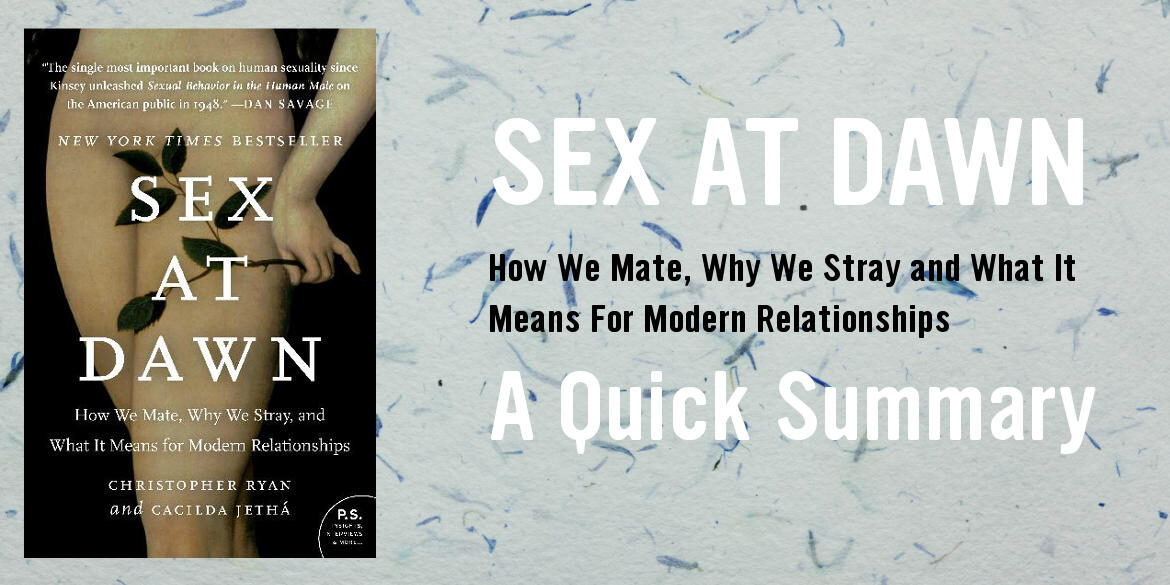
Sex at Dawn: How We Mate, Why We Stray, and What It Means for Modern Relationships explores an alternative and more plausible idea of how sex used to be.
In short, Sex At Dawn proposes the idea that when we lived in small tribes and bands (max 150 people) all resources and child-rearing was shared among all members of the tribe and therefore paternity wasn’t important. Women would have sex with multiple men and men would have sex with multiple women. Relationships existed of course, but they weren’t monogamous.
Aggression and competition isn’t hardwired into us, but cooperation and sharing is. Men wouldn’t compete with each other for exclusive “access” to a woman, their sperm would do all the competition for them. The strongest sperm and therefore genes would win and only the best genes would be passed on, strengthening the human population over time.
This is how anatomically-modern humans lived for roughly 190,000 years and it’s only in the past 12,000 years or so that our sexual habits changed. It was the advent of agriculture which introduced personal ownership and inheritance – this meant that paternity suddenly became very important.
Larger societies where ownership and exclusivity are so important have twisted our natural state of cooperation and resource-sharing. Society has changed, but our biology and brains have stayed largely the same.
Sex At Dawn investigates not only the holes and contradictions in current theories but examines the issue from a social, cultural, biological and psychological viewpoint. It’s a thoroughly fascinating book that goes against commonly accepted theories. I encourage you to pick up a copy and explore this well-considered approach to human sexuality.